


Hydraulic Cylinder Manufacturer | Custom OEM Cylinders – Hidroman
Hydraulic Cylinder Manufacturing | Custom & OEM Hydraulic Cylinders
Hydraulic Cylinder Manufacturing for Industrial and OEM Applications
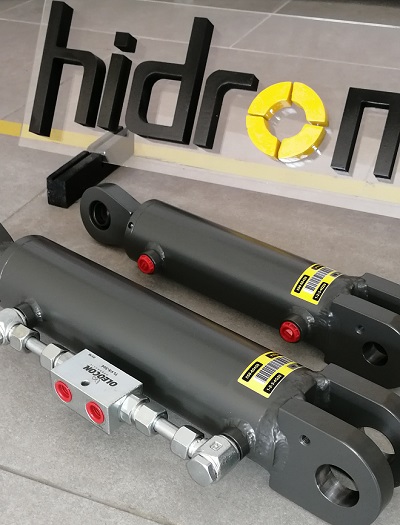
Hydraulic cylinders convert hydraulic energy into mechanical force and linear motion. They are essential components in construction equipment, agricultural machinery, mining systems, steel production facilities, lifting equipment and a wide range of industrial machines.
Choosing the right hydraulic cylinder involves more than selecting a bore diameter and stroke length. Operating pressure, load capacity, rod strength, mounting configuration, operating speed, temperature, sealing requirements and duty cycle must all be considered during the design process.
Hidroman is a hydraulic cylinder manufacturer based in İzmir, Türkiye, providing standard and custom-engineered cylinder solutions for industrial applications and OEM equipment manufacturers. Our capabilities cover engineering, design, manufacturing, assembly and testing.
Hydraulic Cylinder Design and Engineering
Every machine has its own operating conditions and mechanical requirements. A cylinder designed for a mobile crane, for example, may have very different requirements from one used in a steel mill or agricultural implement.
Hidroman's design and R&D team works with customers to understand application requirements and develop suitable hydraulic cylinder designs.
The engineering process may include:
Required extension and retraction forces
Nominal and maximum operating pressure
Cylinder bore and piston rod diameter
Stroke length and installation dimensions
Operating speed and duty cycle
Mounting style and connection geometry
Rod buckling and load conditions
Side loading and mechanical alignment
Operating temperature and hydraulic fluid
Seal material and fluid compatibility
Based on the available technical information, 3D design and strength calculations can be used to evaluate the cylinder before manufacturing. This approach helps address mechanical integration, operating safety and long-term performance from the beginning of the project.
Hydraulic Cylinder Manufacturing in İzmir, Türkiye
Hidroman manages hydraulic cylinder manufacturing processes at its production facility in İzmir, Türkiye.
From engineering and material selection to machining, welding, assembly and final testing, each manufacturing stage is considered in relation to the cylinder's design and intended application.
Key manufacturing and quality processes include:
Production according to approved technical drawings and specifications
3D design and mechanical strength calculations
TIG (argon) welding processes
Honed cylinder tube manufacturing
Hard-chrome-plated piston rods
Application-specific sealing systems
Controlled assembly and cleaning
Internal and external leakage testing
PPAP documentation and traceability for OEM projects, where required
Hidroman Hydraulic Cylinder Product Range
Hidroman develops different hydraulic cylinder designs for mobile equipment, industrial machinery and specialized applications.
1. Agricultural Hydraulic Cylinders
Agricultural hydraulic cylinders are used for lifting, steering, folding, opening, closing and positioning functions in agricultural machinery.
Hidroman's agricultural cylinder product families include:
H1 Series
H2 Series
H3 Series
M1 Series
L2 Series
Technical range:
Nominal pressure: 160–350 bar (approximately 2,320–5,076 psi)
Piston bore: 25–320 mm (approximately 0.98–12.60 in)
Maximum stroke: 6,000 mm (approximately 236 in)
The appropriate cylinder is selected according to machine loads, mounting geometry, operating cycles and required travel distance.
2. Tie-Rod Hydraulic Cylinders
Tie-rod hydraulic cylinders use external threaded rods to hold the cylinder assembly together. They are commonly selected for industrial applications where standardized dimensions and straightforward maintenance are important.
Hidroman product families include:
Series 70
Series 210
Series T3
Technical range:
Nominal pressure: 70–210 bar (approximately 1,015–3,046 psi)
Piston bore: 25–200 mm (approximately 0.98–7.87 in)
Maximum stroke: 3,000 mm (approximately 118 in)
3. Mill-Duty and Heavy-Duty Hydraulic Cylinders
Mill-duty hydraulic cylinders are designed for demanding industrial environments involving high mechanical loads and challenging operating conditions.
Typical applications include:
Rolling mills
Steel production and melting facilities
Industrial presses
Cranes and lifting equipment
Shipbuilding systems
Heavy machinery and structural equipment
Hidroman's mill-duty cylinder range includes welded and threaded designs. Depending on the application, welded cylinder bodies can provide a compact construction while meeting the required mechanical and operational specifications.
4. Large-Bore and Long-Stroke Hydraulic Cylinders
Some applications require high output force, large piston diameters or extended stroke lengths. These projects require careful engineering of the cylinder body, piston rod, bearings, sealing system and mounting geometry.
Hidroman's solutions in this category include:
Large Hydraulic Cylinders (LHC)
Electro-Hydraulic Actuators (EHA)
Electromechanical Actuators (EMA)
Custom welded cylinders
Heavy-duty hydraulic cylinders
Rod buckling calculations, bearing design, welding configuration, sealing performance and mechanical connections are evaluated according to the project requirements.
5. Hydraulic Clamping and Fixture Cylinders
Hydraulic fixture cylinders are used to clamp, support, position and secure workpieces in machining fixtures and industrial production systems.
Hidroman's product solutions include:
Screw-in cylinders
Block cylinders
Finger cylinders
Swing cylinders
Hydraulic supports
Screw-in cylinders are designed to be installed directly into a fixture body. Depending on the design, pressure and pull versions are available. Single-acting, spring-return configurations can also be used where appropriate.
6. Hydraulic Rotary Actuators
Hydraulic rotary actuators convert hydraulic power into controlled angular movement and torque. Their compact construction makes them suitable for applications requiring rotational movement within limited installation space.
Hidroman's rotary actuator product range includes:
8 piston size options
Torque ratings up to 6,750 Nm (approximately 4,978 lb-ft)
Application-specific rotation angles
Maximum operating pressure up to 120 bar (approximately 1,740 psi)
These figures describe the stated product range. The correct model must be selected according to the required torque, rotation angle and operating conditions.
Hydraulic Cylinder Specifications and Standards
Hydraulic cylinder dimensions, mounting arrangements, pressure ratings and operating limits must be selected according to the intended application.
The general technical range stated for Hidroman's cylinder products includes:
| Specification | Technical range |
|---|---|
| Standard mounting configurations | 12 types |
| Piston bore | 40–800 mm (1.57–31.50 in) |
| Piston rod diameter | 22–600 mm (0.87–23.62 in) |
| Maximum stroke | 6,000 mm (236 in) |
| Nominal pressure | 350 bar (5,076 psi) |
| Test pressure | 500 bar (7,252 psi) |
| Optional operating pressure | 700 bar (10,153 psi) |
| Maximum piston speed | 0.5 m/s (19.7 in/s) |
| Viscosity range | 5–300 cSt |
| Standard operating temperature | -20°C to +80°C (-4°F to +176°F) |
| Optional temperature range | -30°C to +200°C (-22°F to +392°F) |
Important: These figures represent the stated general product range, not the specifications of every cylinder model. The actual dimensions, pressure rating and temperature limits must be confirmed for each design. A 700-bar operating pressure is an optional, project-specific configuration requiring appropriate engineering validation.
Applicable Standards
ISO 3320: Dimensional standards for hydraulic cylinder bores and piston rod diameters.
ISO 10100: Acceptance and testing procedures for hydraulic cylinders.
Mounting dimensions and connection configurations should be selected according to the relevant application and project requirements.
Hydraulic Fluid Compatibility
The stated standard fluid group includes mineral hydraulic oils classified as HL and HLP under DIN 51524.
Standard fluid temperature: -20°C to +80°C
Standard operating temperature: -20°C to +80°C
Optional temperature range for special designs: -30°C to +200°C
Viscosity range: 5–300 cSt
Seal materials and internal surface requirements must be compatible with the selected hydraulic fluid and operating temperature.
Materials Used in Hydraulic Cylinder Manufacturing
Cylinder performance depends not only on engineering design but also on material selection, machining accuracy and surface finish.
The materials and surface specifications stated by Hidroman include:
Cylinder tube: Honed St52Bk + S material.
Piston rod: Ck45 steel.
Piston rod surface: Minimum 20 µm hard chrome plating with f7 tolerance.
Piston rod surface quality is important for seal performance, wear resistance and service life. Material and surface treatment requirements should be evaluated according to the operating conditions of each cylinder.
Welding and Manufacturing Quality
Welded connections are critical to the mechanical strength and sealing performance of hydraulic cylinders.
Hidroman uses TIG (argon) welding processes in its cylinder manufacturing operations. Welding procedures are selected according to material characteristics and joint geometry. Where required by the project specification, welding procedures and quality inspections are incorporated into the manufacturing process.
Machining, honing, welding, assembly and leakage testing are treated as interconnected stages of the production process.
Hydraulic Cylinder Testing and Quality Control
A completed hydraulic cylinder must be verified before shipment to ensure that it meets its approved design and operating requirements.
Hidroman cylinders undergo internal and external leakage testing before shipment in accordance with the applicable production quality procedures and prepared PPAP documentation. ISO 10100 is used as the relevant cylinder testing standard.
Quality control activities include:
Verification of manufacturing dimensions and assembly requirements
Cleaning before and after assembly
Testing with suitable hydraulic oil
Internal and external leakage inspection
Production and test record tracking according to project requirements
For OEM projects, Hidroman's quality approach can also include PPAP documentation and lot-based traceability processes.
Hydraulic Cylinder Selection: Key Engineering Considerations
An incorrectly sized or unsuitable hydraulic cylinder can lead to piston rod damage, buckling, bearing wear, seal failure and premature equipment downtime.
The following factors should be evaluated during cylinder selection and machine integration:
Force calculation: Extension and retraction forces must be calculated according to system pressure and piston area.
Mechanical alignment: The cylinder, piston rod and mounting points must be properly aligned.
Side loading: Unintended lateral forces on the piston rod and bearings should be avoided.
Buckling calculation: Rod buckling length and load must be checked according to the mounting configuration.
Operating pressure: The cylinder's maximum permitted pressure must not be exceeded during operation.
Seal compatibility: Seals and other sealing components must be suitable for the hydraulic fluid and temperature.
Operating speed: Maximum piston speed must be evaluated together with seal design and operating conditions.
Fluid cleanliness: Hydraulic fluid cleanliness must meet the requirements of the components in the system.
The reference cleanliness level stated on the product page is ISO 4406 (c) 20/18/15. The actual target cleanliness level should be determined according to the requirements of the pumps, valves and other components used in the hydraulic circuit.
Hydraulic Cylinder Applications
Hydraulic cylinders are used across industries that require controlled linear motion and high mechanical force.
Agricultural machinery and equipment
Mobile cranes and lifting systems
Truck-mounted equipment
Steel mills and rolling mills
Construction and earthmoving equipment
Mining machinery
Industrial presses
Shipbuilding and marine systems
Special-purpose machinery and OEM equipment
Since load, speed, pressure and environmental conditions vary between industries, cylinder design must be tailored to the application.
Warranty, Service and Spare Parts Support
Hidroman-manufactured hydraulic cylinders are covered by a 2-year company warranty under the stated warranty conditions. Service and spare parts support is available for 10 years.
Failures caused by misuse or operation outside the specified conditions are excluded from warranty coverage. Damage during installation and unauthorized product intervention by parties other than Hidroman personnel may also affect warranty validity.
Service and repair activities are carried out by Hidroman personnel.
Hydraulic Cylinder Manufacturer for OEM Companies
Selecting the right hydraulic cylinder manufacturer has a direct impact on machine performance, maintenance requirements and long-term operating costs.
For OEM equipment manufacturers, product compliance is only one part of the decision. Manufacturing consistency, quality documentation, traceability, production capability and after-sales support are equally important.
Based in İzmir, Türkiye, Hidroman develops hydraulic cylinder solutions ranging from standard industrial cylinders to custom-engineered and heavy-duty designs.
To evaluate your project, please provide the following information where available:
Machine or application description
Required extension and retraction force
Operating pressure
Piston bore and rod diameter
Stroke length
Mounting dimensions and connection type
Operating temperature and hydraulic fluid
Technical drawings, 3D models or an existing cylinder sample
Hidroman's engineering team can review your requirements and help determine a suitable hydraulic cylinder design and manufacturing solution.
Contact Hidroman to discuss your hydraulic cylinder manufacturing project.
Frequently Asked Questions
Does Hidroman manufacture hydraulic cylinders in İzmir, Türkiye?
Yes. Hidroman operates its hydraulic cylinder manufacturing facility in İzmir, Türkiye, providing standard and custom-engineered solutions for industrial applications and OEM equipment manufacturers.
What types of hydraulic cylinders does Hidroman manufacture?
Hidroman's product range includes agricultural cylinders, tie-rod cylinders, mill-duty cylinders, welded cylinders, large-bore and long-stroke cylinders, fixture cylinders and custom hydraulic cylinder solutions. Hydraulic rotary actuators and electro-hydraulic actuator applications are also included in its product portfolio.
What is the maximum operating pressure of Hidroman hydraulic cylinders?
The general product range states a nominal pressure of 350 bar (5,076 psi) and a test pressure of 500 bar (7,252 psi). An optional operating pressure of 700 bar (10,153 psi) may be considered for suitable designs following project-specific engineering validation.
Which standards are used for hydraulic cylinder manufacturing?
ISO 3320 is specified for piston and piston rod dimensions, while ISO 10100 is referenced for hydraulic cylinder testing. Additional mounting and connection standards may be considered according to project requirements.
How are hydraulic cylinder bore and stroke dimensions determined?
The bore is calculated according to the required force and system pressure. Stroke length is determined by the required machine movement. Piston rod buckling strength, mounting geometry and operating cycle must also be evaluated.
Which materials are used in Hidroman hydraulic cylinders?
The stated materials include honed St52Bk + S cylinder tubes and Ck45 piston rods. The piston rod surface is specified with at least 20 µm hard chrome plating and f7 tolerance. Special projects may require application-specific material selection.
Are hydraulic cylinders tested before shipment?
Yes. Hidroman cylinders undergo internal and external leakage inspections before shipment according to production quality procedures and the applicable testing requirements. ISO 10100 is referenced as the cylinder testing standard.
Does Hidroman provide warranty and spare parts support?
Hidroman-manufactured hydraulic cylinders are covered by a stated 2-year company warranty, with 10 years of service and spare parts support. Warranty coverage is subject to the product's operating and intervention conditions.
You May Also Be Interested In
Hydraulic Cylinders: Types, Operating Principles and Technical Specifications
Original Hydraulic Cylinder Manufacturing for OEM Manufacturers
Hidroman – The Engineering of Power.
Apple Store Hydraulic Cylinder Calculation
https://apps.apple.com/tr/app/hidroman-hidrolik-hesaplay%C4%B1c%C4%B1/id6473790750?l=tr+