Hydraulic Cartridge Valves | Logic Valves | Hidroman
Hydraulic Cartridge Valves
Compact Hydraulic Control for High-Flow and High-Pressure Applications
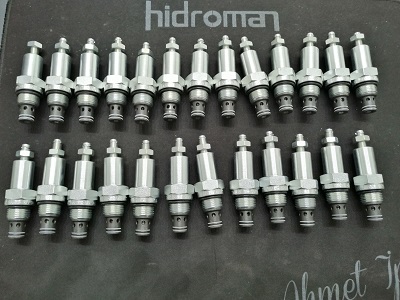
Hydraulic cartridge valves are compact hydraulic control valves designed to manage pressure, flow, and directional functions within a hydraulic manifold or valve block. Also known as cartridge valves, these valves are widely used in mobile equipment, construction machinery, mining equipment, agricultural machinery, industrial hydraulic systems, and custom hydraulic power units.
Unlike conventional inline valves, cartridge valves are installed directly into a machined valve cavity within a hydraulic manifold. This design allows engineers to build compact hydraulic circuits while handling high flow rates and demanding operating pressures.
Hidroman provides hydraulic cartridge valve solutions for applications requiring reliable hydraulic control, compact system design, high flow capacity, and high-pressure performance.
The available product range includes solutions for applications up to 6,090 psi (420 bar) and flow rates from approximately 0.26 to 528 GPM (1–2,000 L/min), depending on valve type and configuration.
What Is a Hydraulic Cartridge Valve?
A hydraulic cartridge valve is a compact hydraulic valve installed into a specially machined cavity inside a hydraulic manifold.
The valve controls hydraulic oil flow according to the required circuit function. Depending on the design, a cartridge valve can be used for:
- Pressure control
- Flow control
- Directional control
- Load holding
- Overpressure protection
- Flow regulation
- Priority control
- Sequence control
- Proportional hydraulic control
Cartridge valves are particularly useful when hydraulic engineers need to integrate several functions into a compact manifold while minimizing external piping and connections.
Hydraulic Cartridge Valve Types
Different cartridge valve designs are available depending on the hydraulic circuit and machine requirements.
Pressure Control Cartridge Valves
Pressure control cartridge valves are used to regulate or limit hydraulic system pressure.
Typical applications include:
- Relief valves
- Pressure reducing valves
- Sequence valves
- Counterbalance valves
- Load control valves
- Pilot-operated pressure valves
These valves can be used to protect hydraulic components and maintain the required pressure within different sections of a hydraulic circuit.
Flow Control Cartridge Valves
Flow control cartridge valves regulate the amount of hydraulic fluid passing through a circuit.
Depending on the application, they can be used for:
- Flow regulation
- Flow sharing
- Priority control
- Flow division
- Pressure-compensated flow control
- Proportional flow control
Proper flow control is essential for controlling actuator speed and maintaining predictable machine performance.
Directional Cartridge Valves
Directional cartridge valves control the path of hydraulic fluid within a hydraulic system.
Common configurations include:
- 2-way cartridge valves
- 3-way cartridge valves
- 4-way cartridge valves
- 2-position valves
- 3-position valves
- Solenoid-operated cartridge valves
- Pilot-operated cartridge valves
- Proportional cartridge valves
Directional cartridge valves are commonly integrated into hydraulic manifolds to control cylinders, hydraulic motors, and other actuators.
Hydraulic Logic Valves
Hydraulic logic valves, also known as logic cartridge valves, are designed for hydraulic circuits requiring high flow capacity and flexible control.
A logic valve typically operates together with a pilot control valve. The pilot valve controls the operating condition of the main cartridge valve, allowing engineers to perform functions such as:
- Directional control
- Pressure control
- Flow control
- Load control
- Unloading
- Sequence control
- Safety and relief functions
Logic cartridge valves are particularly useful in high-flow hydraulic systems where compact manifold construction is important.
Hydraulic Cartridge Valve Manifolds
A major advantage of cartridge valve technology is the ability to integrate multiple hydraulic functions into a single hydraulic manifold.
The manifold contains specially machined cavities and internal passages designed for the selected cartridge valves.
A properly engineered hydraulic manifold can reduce:
- External hydraulic hoses
- Pipe connections
- Potential leak points
- Installation space
- Assembly complexity
The manifold design must be matched to the selected cartridge valves and the hydraulic circuit.
Important design parameters include:
- Valve cavity size
- Operating pressure
- Maximum flow
- Port configuration
- Hydraulic circuit function
- Number of valves
- Internal flow passages
- Material
- Sealing requirements
- Installation dimensions
For custom hydraulic systems, cartridge valve selection and manifold design should be considered together rather than as separate components.
Advantages of Hydraulic Cartridge Valves
Compact Hydraulic System Design
Because cartridge valves are installed directly into a manifold, hydraulic systems can be designed with less external piping and a smaller overall footprint.
High Flow Capacity
Cartridge valve technology is well suited for applications where significant hydraulic flow must be controlled within a compact valve assembly.
Depending on the configuration, Hidroman offers solutions for applications ranging from 1 to 2,000 L/min.
High-Pressure Performance
Hydraulic cartridge valves can be used in demanding high-pressure hydraulic applications.
Selected solutions are available for pressures up to 420 bar / 6,090 psi, depending on the valve design.
Reduced External Connections
Integrating multiple valves into a hydraulic manifold can significantly reduce the number of hoses, fittings, and external connections.
This can simplify installation and reduce potential leakage points.
Low Internal Leakage
Certain poppet-style cartridge valves can provide very low internal leakage, making them suitable for applications where load holding and pressure retention are important.
Fast Hydraulic Response
The right cartridge valve and pilot control configuration can provide fast and predictable hydraulic response for demanding machine applications.
Modular Hydraulic Circuit Design
Multiple cartridge valves can be combined within one manifold to create customized hydraulic circuits for specific machine functions.
Where Are Hydraulic Cartridge Valves Used?
Hydraulic cartridge valves are used across a wide range of mobile and industrial hydraulic applications.
Construction Equipment
Cartridge valves are commonly used in:
- Excavators
- Wheel loaders
- Skid steer loaders
- Backhoe loaders
- Telehandlers
- Cranes
- Material handling equipment
Mining Equipment
Mining machinery often requires high-pressure and high-flow hydraulic systems.
Hydraulic logic valves and cartridge valves can be integrated into mining equipment where compact design and reliable hydraulic control are critical.
Agricultural Machinery
Cartridge valves can be used in:
- Tractors
- Harvesters
- Sprayers
- Agricultural implements
- Hydraulic attachments
Industrial Hydraulic Systems
Industrial applications include:
- Hydraulic presses
- Manufacturing equipment
- Special-purpose machinery
- Hydraulic power units
- Automation systems
- Material handling systems
Mobile Hydraulic Equipment
Cartridge valves are especially useful in mobile hydraulic applications where available installation space is limited and hydraulic functions must be integrated into a compact system.
How to Select a Hydraulic Cartridge Valve
Selecting the correct cartridge valve requires more than simply matching the valve size.
The complete hydraulic operating environment should be evaluated.
- Operating Pressure
Determine both the normal operating pressure and the maximum pressure of the hydraulic system.
The selected valve must be rated appropriately for the application.
- Required Flow Rate
Determine the continuous and peak flow requirements.
An undersized cartridge valve can create excessive pressure drop, heat generation, and reduced system efficiency.
- Valve Cavity
The cartridge valve must match the cavity machined into the hydraulic manifold.
Cavity dimensions and standards should be verified before selecting the valve.
- Hydraulic Function
Determine whether the valve is required for:
- Pressure control
- Flow control
- Directional control
- Load holding
- Relief
- Sequence control
- Proportional control
- Control Method
The appropriate control method may include:
- Hydraulic pilot control
- Solenoid control
- Mechanical control
- Proportional control
- Remote pilot control
- Hydraulic Fluid
The hydraulic fluid type and viscosity should be compatible with the valve and its sealing materials.
- Operating Temperature
The expected minimum and maximum operating temperatures should be considered when selecting the valve and seals.
- Port and Connection Standards
Depending on the hydraulic system, connection requirements may include:
- SAE
- NPT
- ORB
- BSP
- Metric connections
The appropriate connection standard should be selected according to the machine design and regional requirements.
What Is a Valve Cavity?
The valve cavity is the precision-machined opening inside a hydraulic manifold where the cartridge valve is installed.
Cavity compatibility is one of the most important factors when selecting a hydraulic cartridge valve.
The cavity determines the mechanical interface between the valve and manifold. However, matching the cavity size alone does not guarantee compatibility.
Engineers should also verify:
- Valve function
- Pressure rating
- Flow capacity
- Pilot configuration
- Port arrangement
- Seal material
- Spool or poppet design
- Electrical specifications where applicable
For this reason, cartridge valve selection should be based on the complete hydraulic application rather than cavity size alone.
Cartridge Valves vs. Conventional Inline Valves
One of the main reasons engineers choose cartridge valves is the ability to integrate multiple hydraulic functions into a single manifold.
A cartridge valve system can offer:
|
Feature |
Cartridge Valve System |
Conventional Inline System |
|
Installation |
Directly into manifold |
External connection |
|
System footprint |
Compact |
Typically larger |
|
External piping |
Reduced |
More extensive |
|
Manifold integration |
Excellent |
Limited |
|
High-flow applications |
Excellent |
Depends on valve size |
|
Custom hydraulic circuits |
Highly flexible |
Flexible |
|
Leak points |
Potentially reduced |
Typically more connections |
The best solution depends on the machine design, required flow, pressure, serviceability, and total system architecture.
Hydraulic Cartridge Valve Solutions from Hidroman
Hidroman provides hydraulic components and engineering solutions for demanding hydraulic applications.
For cartridge valve applications, the focus is not only on selecting the valve itself. The valve, hydraulic manifold, cavity, flow requirements, pressure rating, control method, and overall hydraulic circuit should be evaluated as one system.
Hidroman can support applications involving:
- Hydraulic cartridge valves
- Cartridge valve systems
- Hydraulic logic valves
- Pressure control valves
- Flow control valves
- Directional cartridge valves
- Solenoid-operated cartridge valves
- Proportional cartridge valves
- Hydraulic valve manifolds
- Custom hydraulic manifolds
- Hydraulic power units
For custom applications, providing the required pressure, flow, valve function, hydraulic schematic, cavity information, and installation requirements helps determine the appropriate cartridge valve solution.
Frequently Asked Questions
What is a hydraulic cartridge valve?
A hydraulic cartridge valve is a compact hydraulic control valve installed into a precision-machined cavity within a hydraulic manifold. It can control pressure, flow, direction, and other hydraulic functions.
Are cartridge valves and logic valves the same?
Not always. A logic valve is a type of cartridge valve technology designed to perform specific hydraulic control functions, often using pilot control. The terms are related but should not always be used interchangeably.
What pressure can hydraulic cartridge valves handle?
The pressure rating depends on the specific valve design. Hidroman offers cartridge valve solutions for applications up to 420 bar / 6,090 psi, depending on configuration.
Can cartridge valves handle high flow?
Yes. High-flow hydraulic control is one of the key applications for cartridge valve technology. Available solutions can cover applications up to approximately 2,000 L/min (528 GPM), depending on valve configuration.
Do cartridge valves require a hydraulic manifold?
Most cartridge valves are designed to be installed into a compatible hydraulic manifold or valve block with the correct cavity.
What industries use cartridge valves?
Cartridge valves are widely used in construction equipment, mining machinery, agricultural equipment, mobile hydraulics, industrial machinery, hydraulic presses, and custom hydraulic systems.
How do I choose the right cartridge valve?
The main factors include operating pressure, flow rate, valve function, cavity size, control method, hydraulic fluid, temperature, sealing requirements, and connection standards.
Can Hidroman provide custom hydraulic manifold solutions?
Yes. Cartridge valve applications can be evaluated together with hydraulic manifold and circuit requirements to develop a suitable hydraulic solution.