Hydraulic Directional Control Valves | Hidroman
Hydraulic Directional Control Valves
Hydraulic Control Valve Solutions for Mobile and Industrial Equipment
Hydraulic directional control valves regulate the flow of hydraulic oil to control cylinders, hydraulic motors, and other actuators. Depending on the valve design and spool configuration, they can stop flow, allow flow, or change the direction of hydraulic fluid.
Hydraulic control valves are essential components in mobile equipment, agricultural machinery, industrial systems, and special-purpose machines. Selecting the correct valve helps ensure that the hydraulic circuit operates within its intended pressure, flow, and control requirements.
Hidroman offers monoblock and sectional hydraulic control valve options with different nominal flow rates, pressure ratings, spool configurations, and actuation methods. Depending on the application, manual lever, mechanical, pneumatic, hydraulic, and electrohydraulic control options may be considered.
What Is a Hydraulic Directional Control Valve?
A hydraulic directional control valve manages the flow paths within a hydraulic circuit. In a spool-type directional valve, a movable spool inside the valve body changes the connections between the pressure port (P), tank port (T), and actuator ports (A and B).
Changing the spool position allows the operator or control system to manage functions such as cylinder extension, cylinder retraction, and hydraulic motor direction.
When selecting a hydraulic control valve, consider nominal flow rate, operating pressure, return-line backpressure, spool configuration, number of sections, actuation method, and hydraulic fluid properties.
Types of Hydraulic Control Valves
Monoblock Hydraulic Control Valves
Monoblock valves use a single main valve body. Their compact design makes them suitable for many mobile hydraulic applications, including agricultural equipment, loaders, and hydraulic attachments.
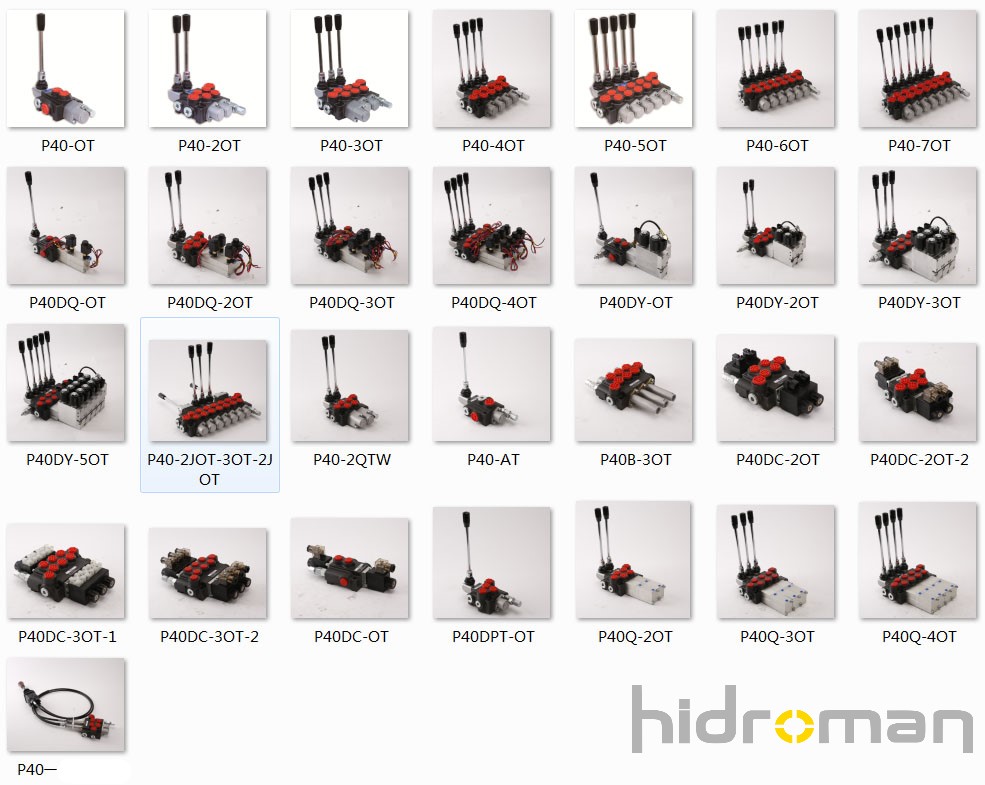
Hidroman lists the P35, P38, P40, P80, and P120 series as monoblock hydraulic control valve options.
Sectional Hydraulic Control Valves
Sectional valves consist of multiple control sections assembled into a valve bank. Each section can be configured to control a separate hydraulic function, subject to the selected spool and valve configuration.
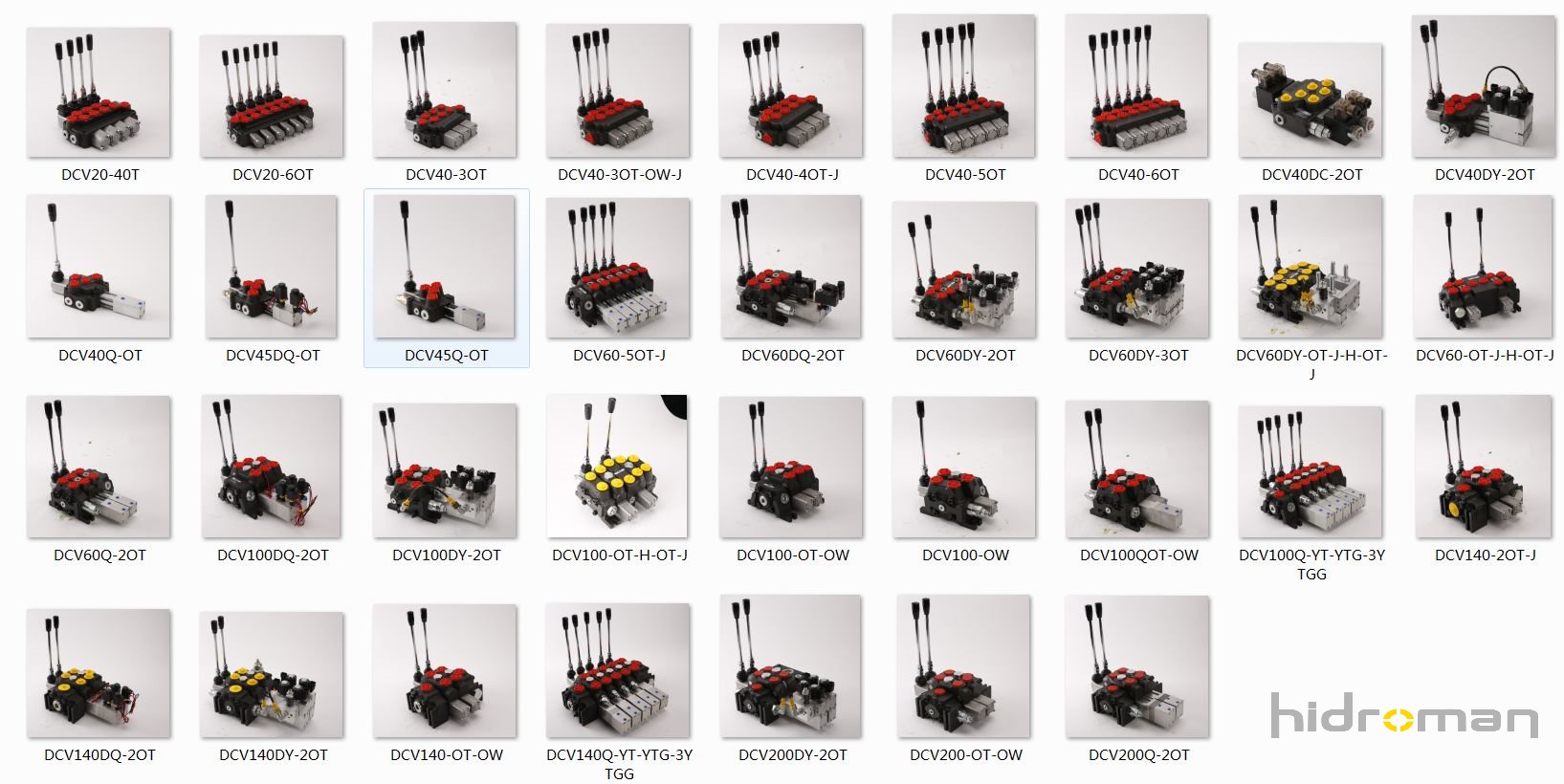
The PC70, PC100, and KS180 series are listed for applications requiring multiple hydraulic functions within a single valve assembly.
Electrohydraulic Control Valves
Electrohydraulic control valves use an electrical command to control hydraulic flow. Depending on the valve configuration, they can be integrated into electrically controlled machine systems.
Hidroman lists electrohydraulic versions of the P40 and P80 series. Confirm the electrical interface, control signal, and valve configuration against the current manufacturer documentation.
Hidroman Hydraulic Control Valve Series and Specifications
The following specifications are based on the current Hidroman product page. Operating limits may vary with the selected spool, actuation method, and valve configuration. Confirm the applicable manufacturer datasheet before specifying or ordering a valve.
1. P35 Monoblock Hydraulic Control Valve
The P35 series is a single-spool monoblock control valve listed with a nominal flow rate of 35 L/min.
Nominal flow rate: 35 L/min
Maximum pressure: P 250 bar, T 50 bar, A/B 300 bar
Spool type: Standard open-center A spool; alternative spool options available
Number of spools: Single
Leakage: 5 cm³/min from A/B to T at 100 bar
Fluid temperature: -10°C to +80°C
Hydraulic fluid: Mineral-based hydraulic oil
Viscosity: 10–100 cSt; 46 cSt recommended
Filtration: Listed as 10 according to NAS 1638
2. P38 Monoblock Hydraulic Control Valve
The P38 series is listed as a single-spool monoblock valve with a nominal flow rate of 35 L/min.
Nominal flow rate: 35 L/min
Maximum pressure: P 250 bar, T 50 bar, A/B 300 bar
Spool type: Standard open-center A spool; alternative spool options available
Number of spools: Single
Leakage: 5 cm³/min from A/B to T at 100 bar
Fluid temperature: -10°C to +80°C
Hydraulic fluid: Mineral-based hydraulic oil
Viscosity: 10–100 cSt; 46 cSt recommended
Filtration: Listed as 10 according to NAS 1638
3. P40 Hydraulic Control Valve
The P40 series offers a nominal flow rate of 40 L/min and multiple spool configurations for mobile hydraulic applications.
Nominal flow rate: 40 L/min
Maximum pressure: P 315 bar, T 50 bar, A/B 300 bar
Spool type: Standard open-center A spool; alternative spool options available
Number of spools: One to seven
Leakage: 5 cm³/min from A/B to T at 100 bar
Fluid temperature: -10°C to +80°C
Hydraulic fluid: Mineral-based hydraulic oil
Viscosity: 10–100 cSt; 46 cSt recommended
Filtration: Listed as 10 according to NAS 1638
4. P80 Hydraulic Control Valve
The P80 series is listed with a nominal flow rate of 80 L/min and multiple spool options for higher-flow hydraulic applications.
Nominal flow rate: 80 L/min
Maximum pressure: P 315 bar, T 50 bar, A/B 300 bar
Spool type: Standard open-center A spool; alternative spool options available
Number of spools: One to six
Leakage: 6 cm³/min from A/B to T at 100 bar
Fluid temperature: -10°C to +80°C
Hydraulic fluid: Mineral-based hydraulic oil
Viscosity: 10–100 cSt; 46 cSt recommended
Filtration: Listed as 10 according to NAS 1638
5. P120 Monoblock Hydraulic Control Valve
The P120 series is listed for applications requiring a nominal flow rate of 120 L/min.
Nominal flow rate: 120 L/min
Maximum pressure: P 250 bar, T 50 bar, A/B 300 bar
Spool type: Standard open-center A spool; alternative spool options available
Number of spools: One to four
Leakage: 8 cm³/min from A/B to T at 100 bar
Fluid temperature: -10°C to +80°C
Hydraulic fluid: Mineral-based hydraulic oil
Viscosity: 10–100 cSt; 46 cSt recommended
Filtration: Listed as 10 according to NAS 1638
6. PC70 Sectional Hydraulic Control Valve
The PC70 series is a sectional valve option for applications requiring several hydraulic functions in one valve assembly.
Nominal flow rate: 70 L/min
Maximum pressure: P 250 bar, T 50 bar, A/B 300 bar
Spool type: Standard open-center A spool; alternative spool options available
Number of sections: One to eight
Leakage: 18 cm³/min from A/B to T at 120 bar
Fluid temperature: -10°C to +80°C
Hydraulic fluid: Mineral-based hydraulic oil
Viscosity: 10–100 cSt; 46 cSt recommended
Filtration: Listed as 10 according to NAS 1638
7. PC100 Sectional Hydraulic Control Valve
The PC100 series is listed for multi-function hydraulic systems requiring a higher flow capacity.
Nominal flow rate: 80 L/min
Maximum flow rate: 100 L/min
Maximum pressure: P 210 bar, T 50 bar, A/B 250 bar
Spool type: Standard open-center A spool; alternative spool options available
Number of sections: One to eight
Leakage: 18 cm³/min from A/B to T at 120 bar
Fluid temperature: -10°C to +80°C
Hydraulic fluid: Mineral-based hydraulic oil
Viscosity: 10–100 cSt; 46 cSt recommended
Filtration: Listed as 10 according to NAS 1638
8. KS180 Sectional Hydraulic Control Valve
The KS180 series is listed with a nominal flow rate of 160 L/min and configurations for systems requiring multiple hydraulic control sections.
Nominal flow rate: 160 L/min
Maximum pressure: 315 bar
Return-line backpressure: 25 bar
Spool type: Standard open-center A spool; alternative spool options available
Number of sections: One to twelve
Leakage: 8 cm³/min from A/B to T at 100 bar
Fluid temperature: -10°C to +80°C
Hydraulic fluid: Mineral-based hydraulic oil
Viscosity: 10–100 cSt; 46 cSt recommended
Filtration: Listed as 10 according to NAS 1638
9. P40 Electrohydraulic Control Valve
The P40 electrohydraulic series is listed for applications requiring electrical control of hydraulic directional functions.
Nominal flow rate: 40 L/min
Maximum pressure: P 315 bar, T 25 bar, A/B 300 bar
Spool type: Standard open-center A spool; alternative spool options available
Number of spools: One to seven
Leakage: 5 cm³/min from A/B to T at 100 bar
Fluid temperature: -10°C to +80°C
Hydraulic fluid: Mineral-based hydraulic oil
Viscosity: 10–100 cSt; 46 cSt recommended
Filtration: Listed as 10 according to NAS 1638
10. P80 Electrohydraulic Control Valve
The P80 electrohydraulic series is listed with a nominal flow rate of 80 L/min for applications requiring electrical control and higher hydraulic flow.
Nominal flow rate: 80 L/min
Maximum pressure: P 250 bar, T 50 bar, A/B 300 bar
Spool type: Standard open-center A spool; alternative spool options available
Number of spools: One to six
Fluid temperature: -10°C to +80°C
Hydraulic fluid: Mineral-based hydraulic oil
Viscosity: 10–100 cSt; 46 cSt recommended
Filtration: Listed as 10 according to NAS 1638
Technical note: The current Hidroman webpage lists leakage for the P80 electrohydraulic series as 18 cm³/min from A/B to T at 120 bar. Confirm this figure against the relevant manufacturer datasheet before using it for engineering calculations.
How to Select the Right Hydraulic Control Valve
A suitable valve should be selected by evaluating the complete hydraulic application rather than maximum pressure alone.
Flow rate: Match the valve's rated flow to the pump output and actuator requirements.
Pressure rating: Check the permitted pressures at P, T, and A/B ports separately.
Spool configuration: Select an open-center or alternative spool arrangement compatible with the hydraulic circuit.
Number of functions: Determine how many cylinders, motors, or other actuators need independent control.
Actuation method: Choose manual lever, mechanical, pneumatic, hydraulic, or electrohydraulic control as required.
Fluid properties: Confirm compatibility with the specified fluid, viscosity, and operating temperature.
Filtration: Maintain oil cleanliness in accordance with the valve manufacturer's requirements.
Return-line backpressure: Ensure tank-line pressure remains within the permitted limit.
Pressure drop, spool characteristics, port sizes, duty cycle, and the machine's operating sequence should also be considered during valve selection.
Applications for Hydraulic Directional Control Valves
Depending on the selected configuration, hydraulic control valves may be used in:
Agricultural machinery and tractor attachments
Construction equipment and loaders
Mobile hydraulic equipment
Cranes and lifting systems
Industrial machinery
Special-purpose machines
Systems requiring independent control of multiple hydraulic actuators
Application suitability depends on the circuit design, required flow and pressure, control functions, and the selected valve's technical specifications.
Frequently Asked Questions
What does a hydraulic directional control valve do?
It controls the direction and routing of hydraulic oil to manage the movement of actuators such as hydraulic cylinders and motors.
What is the difference between a monoblock and a sectional valve?
A monoblock valve uses one main valve body. A sectional valve combines multiple control sections to manage several hydraulic functions.
What is the main difference between the P40 and P80 series?
Hidroman lists the P40 series at a nominal flow rate of 40 L/min and the P80 series at 80 L/min. Pressure limits and other operating characteristics should also be checked for the selected configuration.
When should an electrohydraulic control valve be considered?
Electrohydraulic valves may be suitable when hydraulic functions need to be controlled through an electrical control system. The electrical interface and required control signal must be verified for the selected valve.
Is maximum pressure or flow rate more important when selecting a valve?
Both are essential. The valve must withstand the required operating pressures and provide sufficient flow for the connected actuators.
How can I request a suitable hydraulic control valve from Hidroman?
Share the operating pressure, required flow rate, number of actuators, control method, and port or mounting details. Hidroman can help evaluate the appropriate valve series for your application.
Select the Right Hydraulic Control Valve with Hidroman
Reliable hydraulic performance depends on selecting the right valve and ensuring compatibility across the hydraulic circuit. Hidroman provides technical support for evaluating hydraulic control valves for mobile and industrial equipment.
Contact Hidroman for product information, application assistance, and quotations.
You May Also Be Interested In