Hydraulic Systems: What They Are and How They Work | Industrial Guide by Hidroman
What Is a Hydraulic System?
A hydraulic system is a power transmission technology that uses pressurized fluid to generate, control, and transmit mechanical force. Based on Pascal’s Law, hydraulic systems convert mechanical energy into hydraulic energy and then back into controlled mechanical motion.
In industrial environments, hydraulic systems are preferred for their:
High power density
Precision control
Load stability
Durability under extreme conditions
At Hidroman, we design and supply OEM-grade hydraulic components and complete hydraulic solutions for European industrial applications.
How Do Hydraulic Systems Work?
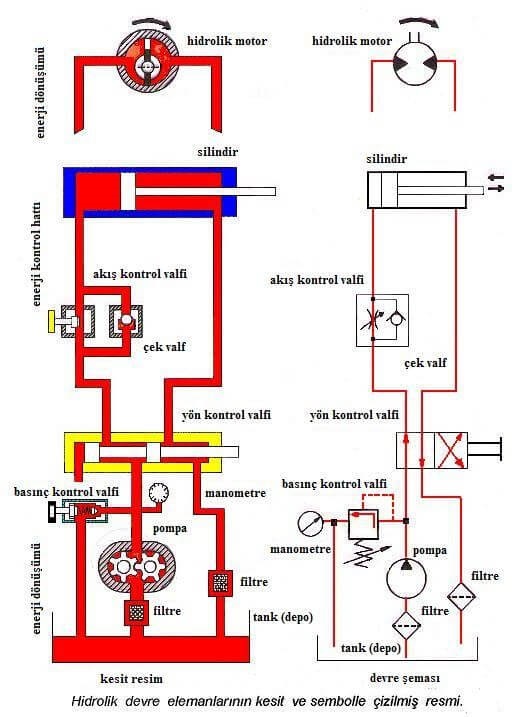
A hydraulic system operates in a closed-loop circuit. The working principle can be summarized in five stages:
Hydraulic fluid is stored and conditioned inside the reservoir. It also supports cooling and air separation.
The pump converts mechanical energy into hydraulic energy by creating fluid flow. Flow combined with resistance generates pressure.
Directional, pressure, and flow control valves regulate:
Flow rate
Operating pressure
Movement direction
This ensures precision control in industrial processes.
Hydraulic cylinders create linear motion, while hydraulic motors generate rotary motion. These components convert hydraulic energy into mechanical output.
Fluid returns to the reservoir after passing through filtration systems that remove contaminants, ensuring long system life and ISO cleanliness compliance.
Core Components of Industrial Hydraulic Systems
|
Component |
Function |
|
Hydraulic Pump |
Generates fluid flow |
|
Hydraulic Cylinder |
Produces linear force |
|
Hydraulic Motor |
Produces rotational motion |
|
Control Valves |
Regulate pressure & direction |
|
Hydraulic Filters |
Protect system from contamination |
|
Reservoir |
Fluid storage and cooling |
|
Hoses & Fittings |
Fluid transmission |
Proper component selection directly impacts system efficiency and lifecycle cost.
Advantages of Hydraulic Systems in Industry
High Force Output
Hydraulic systems can generate extremely high force with compact components.
Precision and Stability
Flow and pressure can be controlled accurately, allowing smooth machine operation.
Overload Protection
Built-in pressure relief systems prevent structural damage.
Reliability in Harsh Conditions
Hydraulic systems operate effectively in heavy-duty industrial environments, including steel production, marine, mining, and construction sectors.
Industrial Applications Across Europe
Hydraulic systems are widely used in:
Construction machinery
Manufacturing and press machines
Marine and offshore equipment
Agricultural machinery
Material handling systems
Automotive production lines
European industries prioritize energy efficiency, environmental compliance, and reliability — making system optimization critical.
Key Engineering Principles Behind Hydraulic Systems
Pascal’s Law
Pressure applied to a confined fluid is transmitted equally in all directions.
Pressure vs. Flow
Pressure determines force
Flow determines speed
Understanding this distinction is essential for correct system sizing.
ISO 4406 Cleanliness Standards
Maintaining proper contamination levels is crucial for long-term system performance and warranty protection.
Why Hydraulic System Design Matters
Poorly designed systems result in:
Energy losses
Excessive heat generation
Short component lifespan
Unexpected downtime
An optimized hydraulic system reduces total cost of ownership (TCO) and improves operational continuity.
Why Choose Hidroman for Hydraulic Solutions?
Hidroman delivers:
OEM-quality hydraulic components
Custom hydraulic system engineering
Filtration and contamination control solutions
European market compliance standards
Technical consulting and performance optimization
We focus on durability, safety, and long-term industrial performance.