Hydraulic Hose Testing Machine: Safety & Standards | Hidroman
What Is a Hydraulic Hose Testing Machine? A Complete Guide to Pressure Testing, Safety, and Standards
Hydraulic hoses transfer pressurized fluid between pumps, valves, cylinders, and other components in hydraulic systems. Selecting the correct hose is essential, but it is only one part of ensuring safe and reliable operation. Proper fitting installation, crimping quality, assembly procedures, and pressure testing are equally important.
An incorrectly crimped fitting, unsuitable hose selection, or manufacturing defect can lead to leakage, fitting separation, or hose failure under pressure. These problems can cause equipment damage, costly downtime, and serious workplace injuries.
A hydraulic hose testing machine, also known as a hose test bench, is designed to evaluate assembled hydraulic hoses under controlled test conditions.
Hidroman provides machinery solutions for hydraulic hose manufacturing and quality control, supporting hose manufacturers, hydraulic service workshops, and industrial operations.
1. Why Is a Hydraulic Hose Testing Machine Important?
The external appearance of a hydraulic hose does not necessarily indicate how it will perform under pressure. Even a hose with no visible damage may contain manufacturing defects or problems in the crimped connection.
A hydraulic hose testing machine helps identify potential issues before the hose is installed in an operating system.
Its main applications include:
Leak testing: Checking hose bodies, fittings, and crimped connections for leakage.
Crimping verification: Evaluating whether the hose and fitting assembly has been manufactured according to the relevant specifications.
Production quality control: Performing defined pressure tests after manufacturing or assembly.
Workplace safety: Conducting tests in a controlled environment with suitable protective enclosures.
Test documentation: Recording test pressure, duration, and results.
Customer quality requirements: Supporting inspection records and traceability procedures.
The objective is not to apply an arbitrary high pressure to every hose. The test procedure must be appropriate for the hose type, applicable standard, and manufacturer's requirements.
2. How Does a Hydraulic Hose Testing Machine Work?
A typical hydrostatic hose test involves filling the hose with a suitable test liquid, removing trapped air, and applying pressure under controlled conditions.
The process generally includes the following stages.
2.1 Hose Preparation
The hose assembly is connected to the test system using suitable adapters and fittings.
Before testing:
Confirm the hose type and size.
Check the suitability of the fittings.
Verify crimp dimensions according to the manufacturer's specifications.
Inspect the hose for cuts, crushing, twisting, or visible damage.
Confirm that the test equipment is suitable for the hose and connection ratings.
Incorrect test connections can invalidate the results and create additional safety risks.
2.2 Filling and Air Removal
Hydrostatic testing generally uses water or a suitable test fluid.
Before pressure is applied, trapped air should be removed from the hose as completely as possible. Compressed gas stores significantly more energy than liquid in a typical hydrostatic test arrangement and can increase the consequences of a failure.
The test fluid must also be compatible with the hose liner and fittings. Corrosion prevention, post-test drying, and cleaning requirements should be considered.
2.3 Controlled Pressure Application
Pressure is gradually increased according to the selected test procedure.
During the test:
Applied pressure is monitored.
The specified test pressure is reached.
Pressure is maintained for the required duration.
The hose body and fittings are evaluated for leakage.
Pressure loss and visible leakage are recorded.
After the test, the system must be depressurized in a controlled manner. The enclosure should only be opened after zero pressure has been confirmed.
3. Types of Hydraulic Hose Tests
Different test methods are used to evaluate hydraulic hose performance. They should not be treated as interchangeable.
3.1 Hydrostatic Pressure Test
Hydrostatic testing evaluates hose integrity and leakage resistance under a specified liquid pressure.
The hose is filled with a suitable test fluid and pressurized according to the applicable standard or manufacturer's procedure.
The main purposes include:
Identifying leakage through the hose body.
Checking fitting connections.
Evaluating crimped areas.
Verifying pressure performance under defined test conditions.
3.2 Proof Pressure Test
A proof pressure test evaluates whether a hose assembly can withstand a specified proof pressure for a defined period.
The purpose is not to rupture the hose. It is to verify acceptable performance under the pressure and duration requirements of the applicable standard or manufacturer's procedure.
The required pressure and hold time depend on the hose type, product standard, and manufacturer specifications.
3.3 Burst Pressure Test
A burst test determines the pressure at which a hose fails under controlled test conditions.
Pressure is increased until the hose ruptures or reaches the defined failure condition.
Burst testing is generally used for product development, type testing, and laboratory evaluation. It is not a routine test for every assembled hose.
Burst testing is destructive. A hose that has undergone a burst test must not be returned to normal service.
3.4 Hydraulic Impulse Test
An impulse test evaluates hose durability under repeated pressure cycles.
The hose is subjected to controlled pressure variations over a specified number of cycles. The test evaluates the hose and fitting assembly under repeated dynamic loading.
Impulse testing is particularly relevant for applications involving vibration, pressure fluctuations, and cyclic operating conditions.
Important: A static hydrostatic hose test bench is not the same as a hydraulic impulse test machine. Impulse testing requires additional control of pressure waveforms, cycle frequency, temperature, and test duration.
4. Hydraulic Hose Testing Standards
The applicable standard depends on hose construction, type, intended application, and manufacturer specifications.
4.1 ISO 1402 – Hydrostatic Testing of Rubber and Plastics Hoses
ISO 1402 specifies methods for hydrostatic pressure testing of rubber and plastics hoses and hose assemblies.
It provides an important reference for conducting hydrostatic tests. However, it does not independently define the working pressure or acceptance criteria for every hose. The applicable product standard and manufacturer documentation must also be considered.
4.2 SAE J517 – Hydraulic Hose
SAE J517 is an important standard covering requirements and performance characteristics for hydraulic hoses.
The relevant hose classification, construction, pressure rating, and performance requirements should be checked against the applicable SAE specification and manufacturer's technical documentation.
4.3 EN 853 – Wire-Braid Hydraulic Hoses
EN 853 covers specified types of rubber hydraulic hoses reinforced with wire braid.
Hose classifications such as 1SN and 2SN are associated with this standard. Working pressure and other technical characteristics vary according to hose size and classification.
4.4 EN 856 – Spiral-Wire Hydraulic Hoses
EN 856 specifies requirements for certain types of rubber hydraulic hoses reinforced with steel wire spirals.
Hose classifications such as 4SP and 4SH are covered by this standard. Testing requirements must be determined according to the applicable product specification and manufacturer's data.
4.5 Selecting the Correct Standard
Compliance with an SAE or EN hose standard does not mean that the pressure requirements of another standard can automatically be applied.
A suitable test procedure should consider:
Hose manufacturer and product code.
SAE or EN hose classification.
Nominal hose size.
Working pressure.
Purpose of the test.
Test fluid.
Test duration and acceptance criteria.
5. Working Pressure, Proof Pressure, and Burst Pressure
Three pressure terms are particularly important when selecting and testing hydraulic hoses.
Working Pressure (WP): The nominal pressure at which the hose is designed to operate under the conditions specified by the manufacturer.
Proof Pressure: A defined test pressure used to verify hose performance according to the applicable standard or manufacturer's procedure.
Burst Pressure: The pressure at which the hose fails during a destructive pressure test.
These values are not interchangeable. Some hose standards specify particular pressure relationships, but there is no single multiplier that applies to every hose.
For example, pressure ratios such as 1.5 times working pressure or 4 times working pressure should only be used when confirmed by the applicable hose standard and manufacturer documentation.
When selecting a test machine, consider both its maximum pressure capacity and the actual test procedure required for the hose.
6. Main Components of a Hydraulic Hose Testing Machine
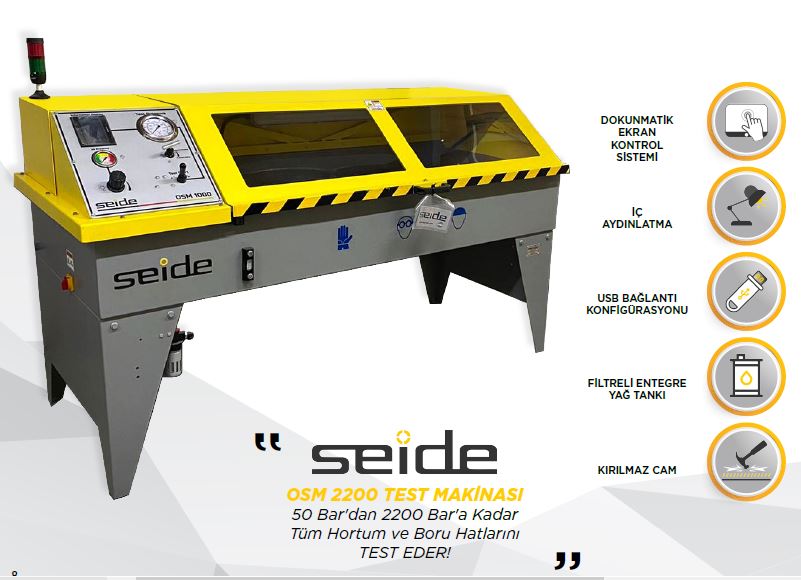
A professional hose testing machine includes mechanical, hydraulic, measurement, and safety components designed to support controlled testing at high pressure.
6.1 High-Pressure Pump
The pump generates the pressure required for testing.
Air-driven high-pressure pumps are commonly used in hose testing applications. Pump selection depends on required pressure, flow rate, test fluid, and operating cycle.
6.2 Pressure Measurement and Control System
Pressure gauges and pressure sensors monitor the pressure applied during the test.
Digital systems can record pressure values electronically. Measurement equipment must be selected for the correct operating range and calibrated at appropriate intervals.
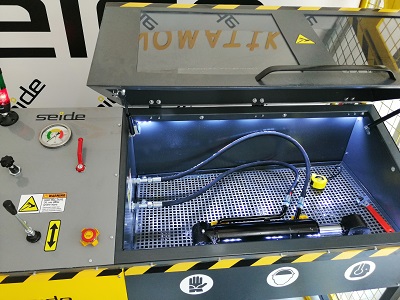
6.3 Test Enclosure and Protective Housing
The test enclosure provides a protected area for the hose and fittings during testing.
High-pressure hose testing requires appropriate structural strength, door interlocks, safety devices, and arrangements that keep operators away from hazardous areas.
If transparent protective materials are used, their suitability for the test pressure and potential impact hazards must be verified through engineering assessment. Ordinary glass or a panel selected only for visibility should not be assumed to provide adequate protection.
6.4 Safety Valves and Pressure Relief System
Suitable pressure relief and safety arrangements help prevent the system from exceeding its permitted pressure limits.
After testing, pressure must be released in a controlled manner. Zero pressure must be confirmed before the enclosure is opened.
6.5 Digital Control and Automatic Reporting
Advanced test systems can record test pressure, hold time, pressure changes, and test results.
These records support quality control, customer documentation, and manufacturing traceability.
An automatically generated report does not, by itself, constitute certification or proof of compliance. The test procedure, measuring equipment, and acceptance criteria must also be properly defined.
7. How to Select the Right Hydraulic Hose Testing Machine
Machine selection should not be based only on maximum pressure capacity. Hose types, test methods, daily testing volume, and safety requirements must all be considered.
7.1 Maximum Test Pressure
The machine's maximum pressure capacity must meet the requirements of the hoses being tested.
High-pressure spiral-wire hoses require particular attention to machine capacity, fittings, connections, and measurement equipment.
A machine capable of reaching 1,000 bar or more does not mean that every hose can or should be tested at that pressure. The correct test pressure must be determined from the applicable standard and manufacturer's instructions.
7.2 Test Enclosure Dimensions
The enclosure must accommodate the length and diameter of the hoses being tested.
Long hoses must be positioned safely, connections must be properly arranged, and uncontrolled hose movement must be prevented.
7.3 Test Fluid and Material Compatibility
The test fluid must be compatible with the hose liner and connection materials.
For water-based test fluids, corrosion risks, post-test drying, and cleaning requirements should be considered. The fluid should meet the hose manufacturer's compatibility requirements.
7.4 Digital Data Recording
Digital pressure monitoring and test reporting can provide significant benefits for hose manufacturers and service workshops with high testing volumes.
Potential recorded data includes:
Hose or work order number.
Test date and time.
Applied test pressure.
Pressure hold duration.
Test result.
Operator information.
Applicable test procedure.
7.5 Daily Testing Capacity
The expected number of hoses tested per day is an important factor in machine selection.
Loading time, pressurization speed, test duration, and unloading time determine the overall testing capacity.
8. Hydraulic Hose Testing Safety
High-pressure hose testing involves significant hazards. Hose or fitting failure can result in high-energy fluid release and flying fragments.
High-pressure fluid injection injuries can cause severe tissue damage, even when the external wound appears small. Immediate medical attention is required if an injection injury is suspected.
Important safety practices include:
Perform tests inside a suitable protective enclosure.
Never pressurize the system while the enclosure door is open.
Use remote-controlled test operation wherever practical.
Ensure all test fittings and adapters have suitable pressure ratings.
Never handle hoses or connections during pressurization.
Never use hands or other body parts to locate a high-pressure leak.
Fully depressurize the system after testing.
Confirm zero pressure before opening the enclosure.
Inspect pressure gauges, sensors, and safety devices regularly.
Train operators in high-pressure testing procedures.
Important safety note: Using compressed air or other compressible gases in place of liquid during hydrostatic testing can create substantially greater stored-energy hazards. The test method must follow the applicable standard and an appropriate engineering procedure.
9. Why Is a Hydraulic Hose Test Report Important?
Recording test results is just as important as performing the test itself.
A test report documents the conditions under which a hose assembly was inspected and the outcome of the procedure.
A professional hose test report may include:
Manufacturer or service company information.
Hose type and nominal diameter.
Hose and fitting product codes.
Hose serial number or work order number.
Test date.
Test standard or procedure reference.
Applied test pressure.
Test duration.
Test fluid.
Measurement equipment details.
Test result.
Operator or quality control approval.
Test reports are valuable for traceability and customer quality requirements. However, a report should only be described as a certificate when the applicable regulatory, standard, and certification requirements have been met.
10. Hidroman Hydraulic Hose Testing Machine Solutions
Hidroman provides hydraulic hose testing machine solutions for hose manufacturing and quality control applications.
These machines can be used to perform defined pressure tests in a controlled manner during hose production and assembly processes.
When evaluating a Hidroman hose testing solution, the following technical requirements can be considered:
Hose diameter and length range.
Hose working and test pressure requirements.
Static hydrostatic testing requirements.
Test enclosure dimensions.
Test fluid selection.
Pressure measurement and control system.
Operator protection and enclosure design.
Digital data recording and reporting requirements.
Daily testing capacity.
Hidroman provides engineering support for evaluating hose testing machine requirements and application-specific machinery solutions.
11. Conclusion: Hydraulic Hose Quality Must Be Verified Through Testing
Hydraulic hose reliability depends on more than the hose brand or external appearance. Correct hose selection, suitable fittings, proper crimping, correct installation, and testing according to the applicable standards must all be considered together.
Hydraulic hose testing machines are an important part of quality control after manufacturing and assembly. With suitable testing equipment, leakage and assembly problems can be identified before a hose enters service.
For professional hydraulic service workshops and hose manufacturers, the right testing machine supports quality assurance, workplace safety, traceability, and customer confidence.
Hidroman supports reliable hydraulic hose quality control with hydraulic hose testing machines and industrial hydraulic engineering solutions.
Frequently Asked Questions
What does a hydraulic hose testing machine do?
It tests assembled hydraulic hoses under defined pressure and time conditions. It helps identify leakage in the hose body and connection points.
What fluid is used for hydraulic hose testing?
Hydrostatic tests generally use water or a suitable test fluid. The fluid must be compatible with the hose liner, fittings, and test procedure.
What pressure is used for hydraulic hose testing?
Test pressure depends on the hose working pressure, applicable product standard, and manufacturer's technical documentation. There is no single test pressure or multiplier that applies to every hose.
What is the difference between a proof test and a burst test?
A proof test verifies acceptable performance at a defined proof pressure. A burst test is a destructive test used to determine the pressure at which a hose fails.
What is ISO 1402?
ISO 1402 specifies hydrostatic pressure test methods for rubber and plastics hoses and hose assemblies.
Are hydrostatic and impulse tests the same?
No. Hydrostatic testing evaluates hose integrity under a specified pressure. Impulse testing evaluates hose durability under repeated pressure cycles.
What should be considered when selecting a hydraulic hose testing machine?
Maximum test pressure, hose diameter and length, enclosure dimensions, test fluid, pressure control, digital reporting, and safety features should all be considered.
Why is hydraulic hose testing important for workplace safety?
Leakage or fitting separation in high-pressure hoses can cause serious injuries. Testing inside a suitable protective enclosure helps identify potential problems in a controlled environment.
Related Articles