


Hydraulic filters play a critical role in protecting hydraulic systems from contamination, premature component wear, and unplanned downtime. By removing solid particles from hydraulic fluid, properly selected filters help protect pumps, valves, hydraulic cylinders, and other precision components.
For industrial machinery, mobile equipment, manufacturing systems, and heavy-duty hydraulic applications, choosing the right hydraulic filter is essential for maintaining fluid cleanliness and reliable system performance.
At Hidroman, we understand that effective hydraulic filtration involves more than selecting a filter based on micron rating alone. Operating pressure, flow rate, fluid viscosity, filtration efficiency, contamination levels, and the required cleanliness target must all be considered.
In this guide, you'll learn what hydraulic filters do, the main types of hydraulic filters, and how to choose the right hydraulic filtration solution for your application.
A hydraulic filter is a component designed to remove contaminants from hydraulic fluid as it circulates through a hydraulic system. These contaminants may include metal particles, dust, dirt, debris introduced during assembly, and wear particles generated during operation.
Water contamination and fluid degradation may also affect hydraulic system performance, although these problems may require specialized treatment beyond conventional particulate filtration.
Hydraulic contamination can accelerate component wear, interfere with valve operation, reduce system reliability, and increase maintenance costs. Proper filtration helps control these risks and supports consistent equipment performance.
A typical hydraulic filter assembly may include:
Filter element: Captures contaminants using a suitable filtration medium.
Filter housing: Contains the filter element and withstands the required operating conditions.
Inlet and outlet connections: Connect the filter to the hydraulic circuit.
Differential pressure indicator: Helps identify increasing restriction across the filter element.
Bypass valve: Allows fluid to bypass the element when a specified differential pressure is reached, if the filter incorporates this feature.
The exact configuration depends on the hydraulic circuit, operating conditions, and equipment manufacturer's specifications.
Hydraulic fluid transmits power, lubricates moving components, and helps carry heat away from critical parts. Contamination can compromise these functions and contribute to premature equipment failure.
Effective hydraulic oil filtration helps:
Reduce abrasive wear in hydraulic pumps, motors, and valves.
Protect proportional and servo valves from particle contamination.
Maintain the required hydraulic fluid cleanliness level.
Reduce contamination-related maintenance and repair costs.
Improve equipment availability and operational reliability.
Support longer component service life when combined with proper maintenance.
Filtration alone cannot prevent every hydraulic failure. Correct system design, suitable fluid selection, temperature control, proper installation, and regular condition monitoring are also important.
Different hydraulic filters serve different purposes depending on where they are installed, which components they protect, and the operating conditions of the hydraulic circuit.
Hydraulic suction filters are installed in the pump inlet path or inside the hydraulic reservoir to capture larger contaminants before they reach the pump.
Their primary purpose is to provide protection against coarse particles. However, suction filtration must be selected carefully because excessive flow restriction can reduce pump inlet pressure and contribute to cavitation.
Typical applications include:
Hydraulic reservoirs and pump inlet circuits.
Systems requiring coarse contaminant control.
Hydraulic equipment where the pump manufacturer's inlet requirements must be observed.
Selection tip: Do not select a suction filter based on micron rating alone. Evaluate pressure drop at the actual flow rate and fluid viscosity, particularly during cold starts.
Fine filtration is often better handled by appropriately designed pressure line, return line, or offline filtration systems rather than by unnecessarily restricting the pump inlet.
Hydraulic pressure line filters are installed downstream of a hydraulic pump or at another suitable location in a pressurized circuit. They help protect sensitive components by capturing contaminants before the fluid reaches them.
Because these filters operate under pressure, their housings and elements must be suitable for the maximum operating pressure and expected pressure transients.
Pressure line filters are commonly used to protect:
Proportional and servo valves.
Hydraulic motors and actuators.
Precision control components.
Critical circuits in industrial and mobile hydraulic equipment.
Important selection criteria include:
Maximum working pressure and pressure spikes.
Required filtration efficiency.
Rated flow capacity.
Initial and terminal differential pressure.
Filter element collapse resistance.
Compatibility with the hydraulic fluid.
Pressure ratings vary by model. Always verify the manufacturer's specifications rather than relying on a general pressure range for the filter category.
Hydraulic return line filters clean fluid as it flows back toward the reservoir. They capture contaminants generated during operation before those particles can accumulate in the tank and circulate through the system again.
Because return line filters generally operate at lower pressures than pressure line filters, they can provide an economical approach to contamination control in many hydraulic applications.
Key benefits include:
Capturing wear particles before fluid returns to the reservoir.
Helping maintain hydraulic fluid cleanliness.
Supporting contamination control throughout the hydraulic circuit.
Providing convenient access for filter element maintenance in suitable installations.
Selection tip: Calculate the maximum return flow rather than relying only on pump flow. Cylinder differential areas, accumulator discharge, and other circuit conditions can increase return flow beyond the pump's rated output.
The filter's allowable return pressure, pressure drop, and bypass characteristics must also be compatible with the system design.
Offline filtration systems, also known as kidney loop filtration systems, clean hydraulic fluid through a separate circulation circuit that operates independently of the main hydraulic circuit.
This arrangement allows fluid to be filtered while the machine is idle or operating, provided the installation and operating conditions permit it.
Offline filtration is particularly useful for large reservoirs, industrial hydraulic power units, and equipment that requires consistent contamination control.
Benefits may include:
Continuous or scheduled fluid cleaning.
Additional filtration capacity without relying entirely on the main hydraulic circuit.
Flexible filter selection for specific cleanliness targets.
Integration with water-removal or fluid-conditioning equipment when required.
An offline filtration system should be designed around reservoir volume, desired cleaning time, oil viscosity, contamination levels, and the target cleanliness code.
For applications requiring additional oil cleaning or fluid conditioning, Hidroman can help evaluate the appropriate hydraulic filtration approach.
Selecting the right hydraulic filter requires evaluating the complete hydraulic circuit rather than focusing on a single specification.
The following criteria help engineers, maintenance teams, and equipment manufacturers identify an appropriate filtration solution.
The required cleanliness level should be based on the most contamination-sensitive components in the system and the equipment manufacturer's recommendations.
Servo valves and other precision components may require cleaner fluid than less sensitive hydraulic equipment.
The ISO 4406 cleanliness code is widely used to classify solid particle contamination in hydraulic fluids. It reports particle counts in three size categories:
Particles equal to or larger than 4 µm(c).
Particles equal to or larger than 6 µm(c).
Particles equal to or larger than 14 µm(c).
For example, an ISO 4406 code of 18/16/13 represents a specific measured contamination level. It is not a universal cleanliness target for every hydraulic system.
The appropriate target depends on the pump, valves, operating conditions, and equipment manufacturer's requirements.
Practical recommendation: Establish the target cleanliness code before selecting the filter element. Then determine the filtration performance required to maintain that target under actual operating conditions.
Micron rating describes a filter's particle-size performance under specified conditions. However, the micron rating alone does not fully describe how efficiently a filter captures contaminants.
Two filter elements with the same nominal micron rating may have significantly different filtration efficiencies.
The beta ratio, commonly expressed as βx(c), provides a more useful way to compare filtration performance at a specified particle size.
The beta ratio is calculated as:
βx = Number of particles upstream / Number of particles downstream
The corresponding single-pass particle capture efficiency is:
Filtration efficiency (%) = (1 − 1/βx) × 100
For example, a filter with a beta ratio of β10(c) = 200 has a calculated efficiency of 99.5% at the specified 10 µm(c) particle size under the applicable test conditions.
This does not mean every particle larger than 10 microns will be captured, nor does it guarantee a particular system cleanliness code. Actual performance depends on contamination loading, fluid flow, filter condition, and the overall system design.
What to look for: Compare documented beta ratios, applicable test methods, and filter element specifications rather than relying exclusively on nominal micron ratings.
A hydraulic filter must accommodate the actual fluid flow through its circuit.
Flow capacity affects pressure drop, filtration performance, contaminant loading, and filter element service life.
When selecting a hydraulic filter, consider:
Maximum operating flow.
Peak and intermittent flow conditions.
Oil viscosity during startup and at operating temperature.
Expected contamination loading.
The manufacturer's recommended flow limits.
A filter that is too small may create excessive restriction. An unnecessarily oversized filter may increase installation costs without delivering a meaningful operational benefit.
Operating pressure and differential pressure are two different specifications.
Operating pressure is the pressure that the filter housing must safely withstand.
Differential pressure (ΔP) is the pressure difference between the filter inlet and outlet. It generally increases as the filter element collects contaminants or as fluid viscosity increases.
A suitable filter should provide an acceptable initial pressure drop at the intended flow rate and viscosity, with sufficient capacity for the expected contamination load.
Also evaluate:
Maximum allowable differential pressure.
Bypass valve opening pressure, if fitted.
Filter element collapse rating.
Pressure surges and transient operating conditions.
Differential pressure indicator settings.
A bypass valve can help prevent excessive restriction, but it may also allow unfiltered fluid to circulate through the system. Its use and setting should therefore follow the equipment manufacturer's requirements and the consequences of bypass operation.
The filter medium affects particle capture, dirt-holding capacity, pressure drop, and service life.
Common hydraulic filter media include:
Wire mesh and metal media
Often used for coarse filtration and applications where a durable, cleanable element is appropriate. Performance depends on the specific design and particle retention characteristics.
Cellulose media
Used in certain hydraulic filtration applications. Its suitability depends on the required filtration efficiency, fluid compatibility, and operating conditions.
Synthetic and glass-fiber media
Frequently used in high-efficiency hydraulic filter elements. Depending on the design, these materials can provide fine particle capture and high dirt-holding capacity.
Filter media must be compatible with the hydraulic fluid, additives, operating temperature, and any relevant water exposure.
Conventional particulate filters are primarily designed to remove solid particles. They do not necessarily remove dissolved water or all other fluid contaminants.
If water contamination is present, the appropriate solution depends on whether the water is free, emulsified, or dissolved.
Possible measures include:
Identifying and eliminating the source of water ingress.
Using a suitable water-removal or dehydration system.
Monitoring fluid condition through oil analysis.
Inspecting reservoir seals, breathers, and cooling systems.
Oxidation products and chemical degradation may also require fluid analysis and, where appropriate, oil replacement or specialized treatment.
Before specifying a hydraulic filter, confirm the following information:
Hydraulic system type and application.
Required ISO 4406 cleanliness target.
Maximum and normal operating flow rate.
Maximum working pressure.
Hydraulic oil type, viscosity, and operating temperature.
Required filtration efficiency and beta ratio.
Acceptable initial and terminal differential pressure.
Filter housing connection size and mounting arrangement.
Bypass valve and clogging indicator requirements.
Filter element availability and maintenance interval.
Water contamination or other fluid-conditioning requirements.
This information helps prevent common selection errors and supports a filtration solution suited to actual operating conditions.
Even a correctly selected hydraulic filter cannot compensate for every contamination source or mechanical problem. Effective contamination control combines filtration with regular monitoring and appropriate maintenance practices.
Oil analysis can help identify changes in particle contamination, water content, viscosity, and other indicators of fluid condition. Depending on the application, a particle counter can be used to assess the ISO 4406 cleanliness code.
These measurements help maintenance teams evaluate whether the current filtration strategy is effective and whether corrective action is needed.
A practical maintenance program should include:
Monitoring fluid cleanliness at appropriate intervals.
Inspecting filter restriction indicators.
Replacing filter elements according to manufacturer recommendations and operating conditions.
Checking reservoir breathers, seals, and filling procedures.
Investigating recurring contamination instead of repeatedly replacing filter elements without identifying the source.
The appropriate monitoring frequency depends on equipment criticality, contamination risk, operating environment, and maintenance requirements.
Several common mistakes can reduce filtration performance or increase operating costs.
Choosing a filter based only on micron rating: Filtration efficiency, beta ratio, flow capacity, and pressure drop are also important.
Ignoring cold-start viscosity: Cold hydraulic oil can create substantially higher pressure drop than oil at normal operating temperature.
Installing an overly restrictive suction filter: Excessive inlet restriction can contribute to pump cavitation and damage.
Using an unsuitable bypass setting: An incorrect setting may allow unfiltered fluid to circulate or create excessive restriction.
Ignoring the source of contamination: Replacing filters without addressing dirt ingress, wear debris, or water contamination may not solve the underlying problem.
Using the same cleanliness target for every system: Required fluid cleanliness depends on the most sensitive components and the equipment manufacturer's specifications.
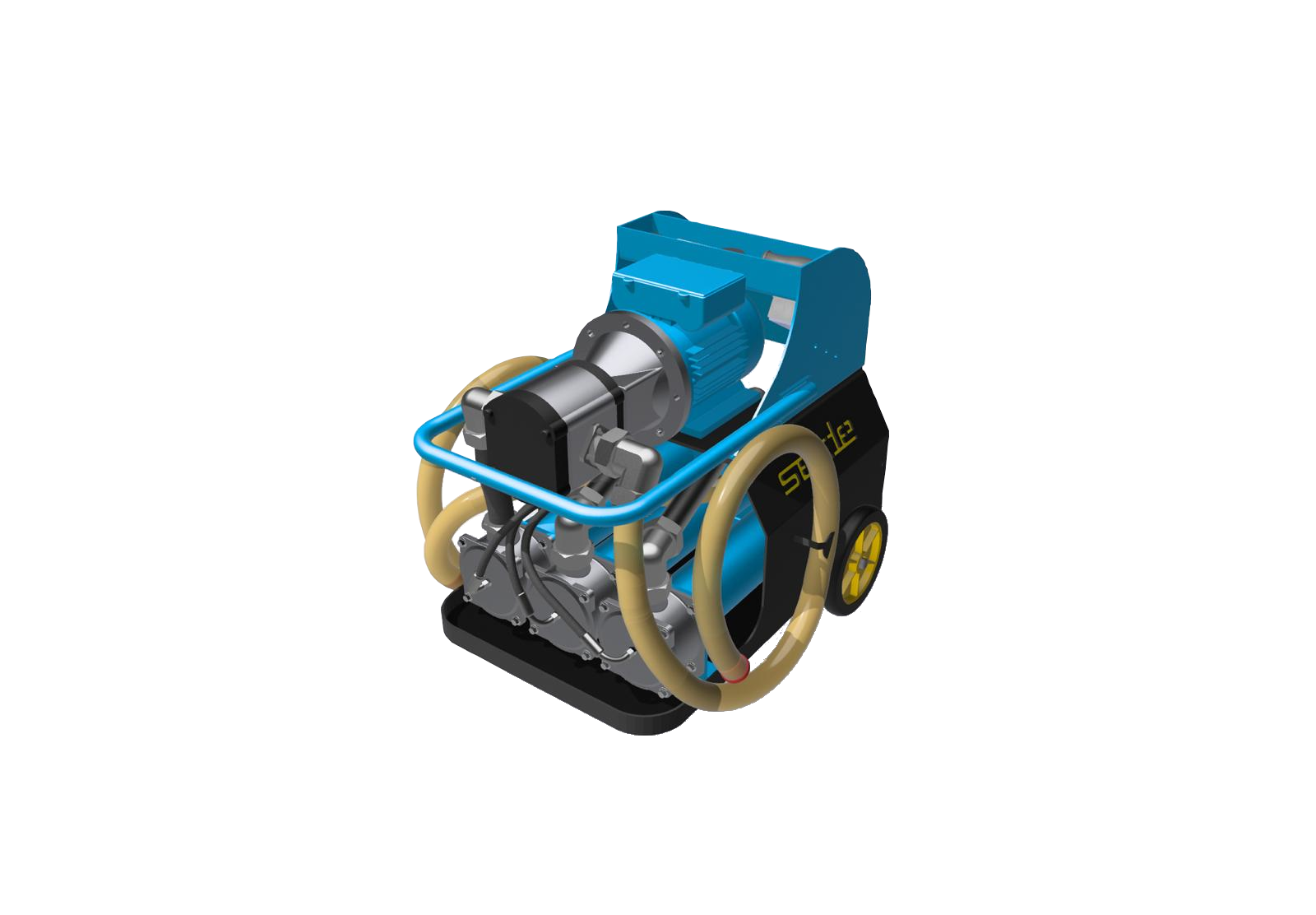
Reliable hydraulic filtration starts with understanding the equipment, operating conditions, and required fluid cleanliness level.
Hidroman provides hydraulic system solutions and filtration-related equipment for industrial applications, OEM projects, and maintenance operations. Depending on the application, suitable solutions may include hydraulic filters, filtration carts, offline filtration systems, and hydraulic oil flushing equipment.
When evaluating a filtration requirement, the Hidroman team can help assess key parameters such as flow rate, operating pressure, fluid condition, and the desired cleanliness target.
Whether you are maintaining an existing hydraulic power unit or specifying filtration for a new system, selecting the right equipment can help protect valuable components and improve maintenance planning.
Contact Hidroman with your system flow rate, operating pressure, hydraulic oil type, and target ISO 4406 cleanliness level. These details help determine which filtration approach is appropriate for your application.
Explore Hidroman's hydraulic filtration solutions and discuss your requirements with our team.